

Network Configuration Management for Dummies (and Smarties Too!)
AI Overview:
Network Configuration Management (NCM) is your network’s built-in safety system — tracking, controlling, and backing up every router, switch, and firewall configuration so nothing slips through the cracks. The blog explains how automated NCM tools prevent the #1 cause of major outages — misconfigurations — while improving security, compliance, and recovery speed.
In simple terms: NCM keeps your network organized, secure, and easy to fix when things go wrong. It works hand-in-hand with monitoring tools, ensuring devices are set up correctly before performance issues even occur.
In a world of hybrid clouds, IoT, and nonstop updates, automation is no longer optional. Modern NCM platforms help businesses eliminate human error, reduce downtime, and maintain “golden” configurations across all systems. The takeaway: with smart configuration management, your network stops being a headache and becomes a competitive advantage.
[lwptoc]Network Configuration Management: #1 Essential Guide
Why Network Configuration Management is Your Network's Best Friend
Network configuration management is the practice of systematically tracking, controlling, and maintaining the settings and configurations of all devices in your network infrastructure. It's like having a detailed blueprint and maintenance record for every router, switch, firewall, and server in your organization. Quick Answer for Network Configuration Management:- What it is: Automated tools that backup, monitor, and manage device settings across your network
- Why it matters: Prevents costly outages (45% are caused by configuration failures) and security breaches
- Key benefits: Faster incident recovery, automated compliance, reduced human error, and improved security
- Best for: Any business with more than a few network devices that can't afford downtime
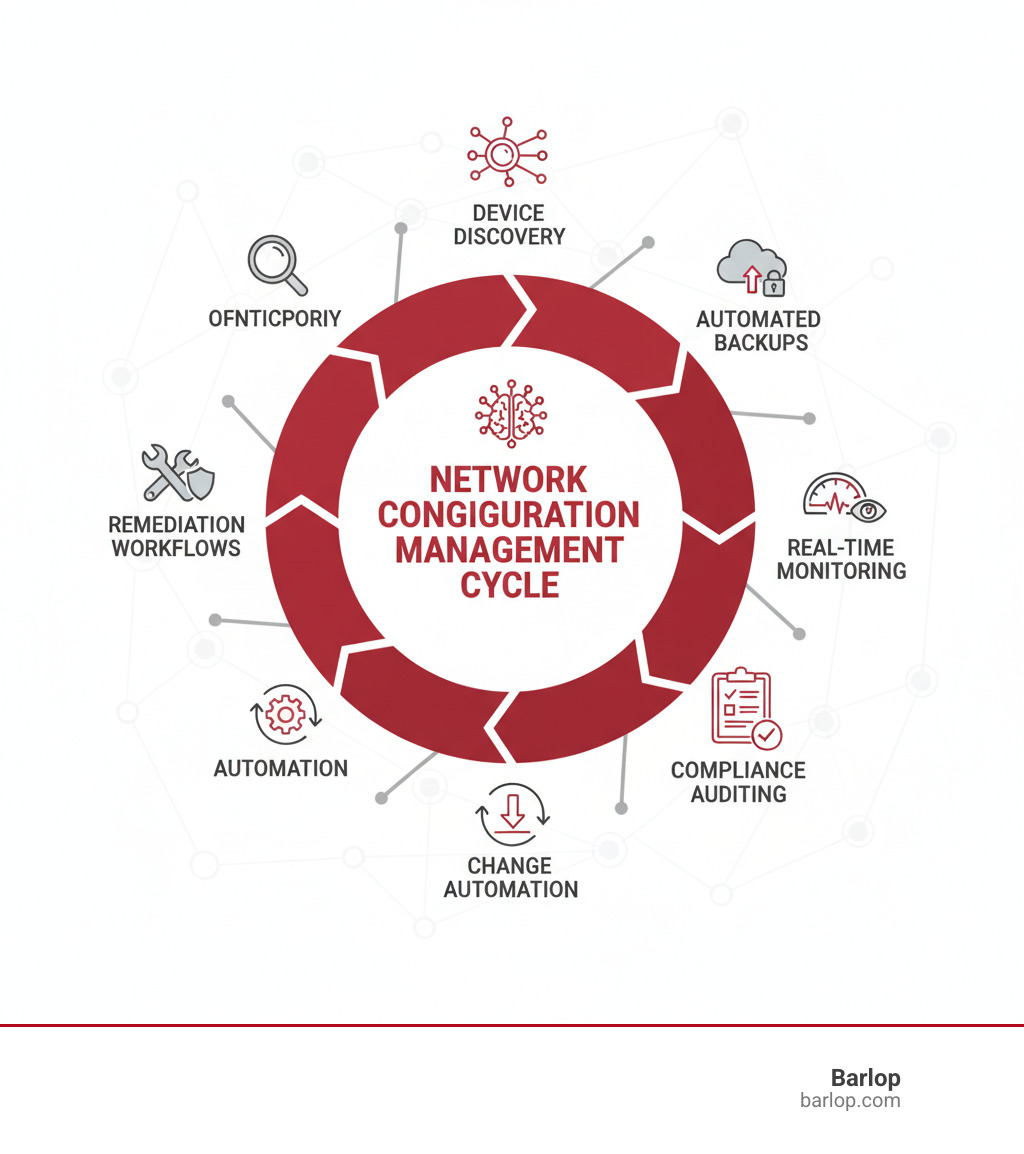 Key terms for network configuration management:
What is Network Configuration Management (NCM)?
Think of network configuration management (NCM) as your network's personal assistant—one that never sleeps, never forgets, and always knows exactly where everything is supposed to be. At its core, NCM is the systematic practice of tracking, controlling, and maintaining every setting on every device across your network infrastructure. But let's break that down into human terms. Your network is made up of dozens, maybe hundreds of devices—routers, switches, firewalls, servers—each with its own complex set of configurations. Without proper management, keeping track of all these settings is like trying to remember every book in a library that's constantly being reorganized by different people who don't talk to each other. Network configuration management creates order from this chaos. It automatically backs up device settings, tracks changes, and ensures everything stays consistent with your organization's policies and regulatory requirements. Gone are the days of frantically typing commands into a command-line interface at 2 AM, hoping you remember the right syntax while your entire network is down. The beauty of modern NCM lies in its evolution from those manual, error-prone processes to automated systems that provide a single source of truth for all your network configurations. It's like having a master blueprint that's always up-to-date, always accurate, and always ready when you need it most. For a deeper understanding of how NCM fits into your overall network strategy, check out A Comprehensive Guide to Effective Network Management. You can also explore more about the fundamental concepts at What is Network Configuration Management?The Core Purpose: Your Network's Master Blueprint
Here's where network configuration management really shines: systematic tracking of every IT asset, its current status, and how it relates to everything else in your network. It's comprehensive lifecycle management that follows devices from the moment they join your network until they're eventually retired. Picture this scenario: It's Tuesday morning, and a critical firewall suddenly fails. Without NCM, your team would spend hours—maybe even days—rebuilding its configuration from scratch, piecing together settings from memory, documentation (if it exists), and guesswork. Your business operations grind to a halt, and every minute costs money. With proper NCM in place, that same scenario plays out very differently. The system immediately identifies the failure, and within minutes, your team can restore the exact configuration from a verified backup. What could have been a disaster becomes a minor hiccup. This proactive approach focuses on reducing downtime, identifying erroneous changes before they cause problems, and ensuring consistent operation across your entire infrastructure. It's about performance optimization through prevention rather than cure—turning your IT team from firefighters into architects.NCM vs. Network Monitoring: What's the Difference?
Many people confuse network configuration management with network monitoring, but they're actually complementary partners with very different jobs. Think of your network like a car: NCM makes sure all the parts are installed correctly and tuned properly, while monitoring checks whether the car is actually running well.| Feature | Network Configuration Management (NCM) | Network Monitoring |
|---|---|---|
| Primary Focus | The state and settings of network devices. | The performance and availability of network devices and services. |
| Key Question | "Is this device configured correctly?" "Has anything changed?" | "Is this device up?" "How much traffic is it handling?" "Is it slow?" |
| Approach | Proactive: Defines, enforces, and backs up desired configurations. | Reactive/Proactive: Alerts when performance deviates or failures occur. |
| Activities | Backup, restore, change management, compliance, auditing, automation. | Uptime checks, traffic analysis, latency, packet loss, resource usage. |
| Goal | Ensure consistency, security, and the ability to recover quickly. | Identify performance issues, outages, and bottlenecks. |
Why NCM is Crucial in Today's Hybrid World
 Remember when networks were simple? When everything lived in one building, behind one firewall, managed by one team? Those days are long gone. Today's networks are sprawling, complex ecosystems that span physical data centers, private clouds, and multiple public cloud providers all at once.
This isn't just about having more devices to manage (though there are certainly more of those). It's about dealing with fundamentally different types of infrastructure that all need to work together seamlessly. Your employees might be connecting from home offices, coffee shops, and client sites. Your applications might be running partly on Amazon Web Services, partly in your own server room, and partly on Microsoft Azure.
Add to this mix the explosion of IoT devices - everything from smart thermostats to industrial sensors - and you've got a network that's more like a living organism than the predictable, contained systems of the past. Each of these elements needs to be configured correctly, secured properly, and maintained consistently.
The challenge becomes even more daunting when you consider that 73% of enterprises have experienced security and compliance issues simply because their network teams and cloud teams don't communicate effectively. When your infrastructure spans multiple domains and involves multiple teams, maintaining consistent network configuration management becomes both more critical and more difficult.
For organizations struggling with this complexity, understanding network security fundamentals becomes essential. The Uptime Institute's 2023 Annual Outage Analysis shows just how costly these configuration failures can be in our increasingly connected world.
The High Cost of Doing Nothing
Here's a sobering reality check: configuration management failure causes 45% of all major network outages. That means nearly half of the times your network goes down, it's because someone made a mistake with a device setting, or because an important configuration change wasn't properly managed. But it gets worse. These aren't just minor hiccups that inconvenience a few users for a few minutes. More than two-thirds of all major outages now cost organizations over $100,000. For many businesses, that's a devastating financial hit that can impact everything from quarterly earnings to annual bonuses. The ripple effects extend far beyond the immediate downtime costs. When your network isn't properly configured, you're essentially leaving the door open for security vulnerabilities. Cybercriminals actively scan for misconfigured devices because they know these are often the easiest way into a network. A single misconfigured firewall rule or an unpatched device can become the entry point for a breach that costs millions. Compliance penalties are another hidden cost of poor configuration management. Industries like healthcare (HIPAA), finance (PCI DSS), and others have strict requirements about how network devices must be configured. When auditors find inconsistencies or violations, the fines can be substantial - and the reputational damage even more costly. Perhaps most frustrating is the operational inefficiency that comes with manual configuration management. Your talented IT staff ends up spending their time on repetitive, error-prone tasks instead of working on projects that actually move your business forward. Every hour spent manually updating firewall rules or troubleshooting a misconfigured router is an hour not spent on innovation. Human error remains the biggest wild card in all of this. Even the most experienced network engineers make mistakes, especially when they're working under pressure to restore service during an outage. Without proper configuration management tools and processes, these mistakes are inevitable.How NCM Boosts Security and Ensures Compliance
Think of network configuration management as your organization's immune system. Just as your body constantly monitors for threats and maintains healthy function, NCM continuously watches your network configurations, ensuring they stay secure and compliant. Automated audits are perhaps the most powerful security feature of modern NCM solutions. Instead of waiting for annual compliance reviews or hoping someone notices a misconfiguration, these systems continuously check every device against established security policies. Whether you need to comply with HIPAA for healthcare data, PCI DSS for payment processing, or SOX for financial reporting, NCM tools can automatically verify that your configurations meet these requirements 24/7. The concept of policy enforcement through "golden configurations" is for security. Instead of hoping each network engineer remembers all the security requirements, you define the perfect, secure configuration once, and the NCM system ensures every device matches this template. Any deviation gets flagged immediately, whether it's caused by human error, a software bug, or potentially malicious activity. Detecting unauthorized changes is where NCM really shines from a security perspective. Every modification to every device gets logged with details about who made the change, when they made it, and exactly what changed. This creates an audit trail that's invaluable for both security investigations and compliance reporting. The results speak for themselves: 97% of customers report improved security posture after implementing proper configuration management. This isn't just about checking compliance boxes - it's about fundamentally strengthening your organization's defenses against cyber threats. For organizations looking to take their security to the next level, exploring managed security services can provide the expertise and 24/7 monitoring that internal teams often can't match.Key Features and Benefits of a Modern NCM Solution
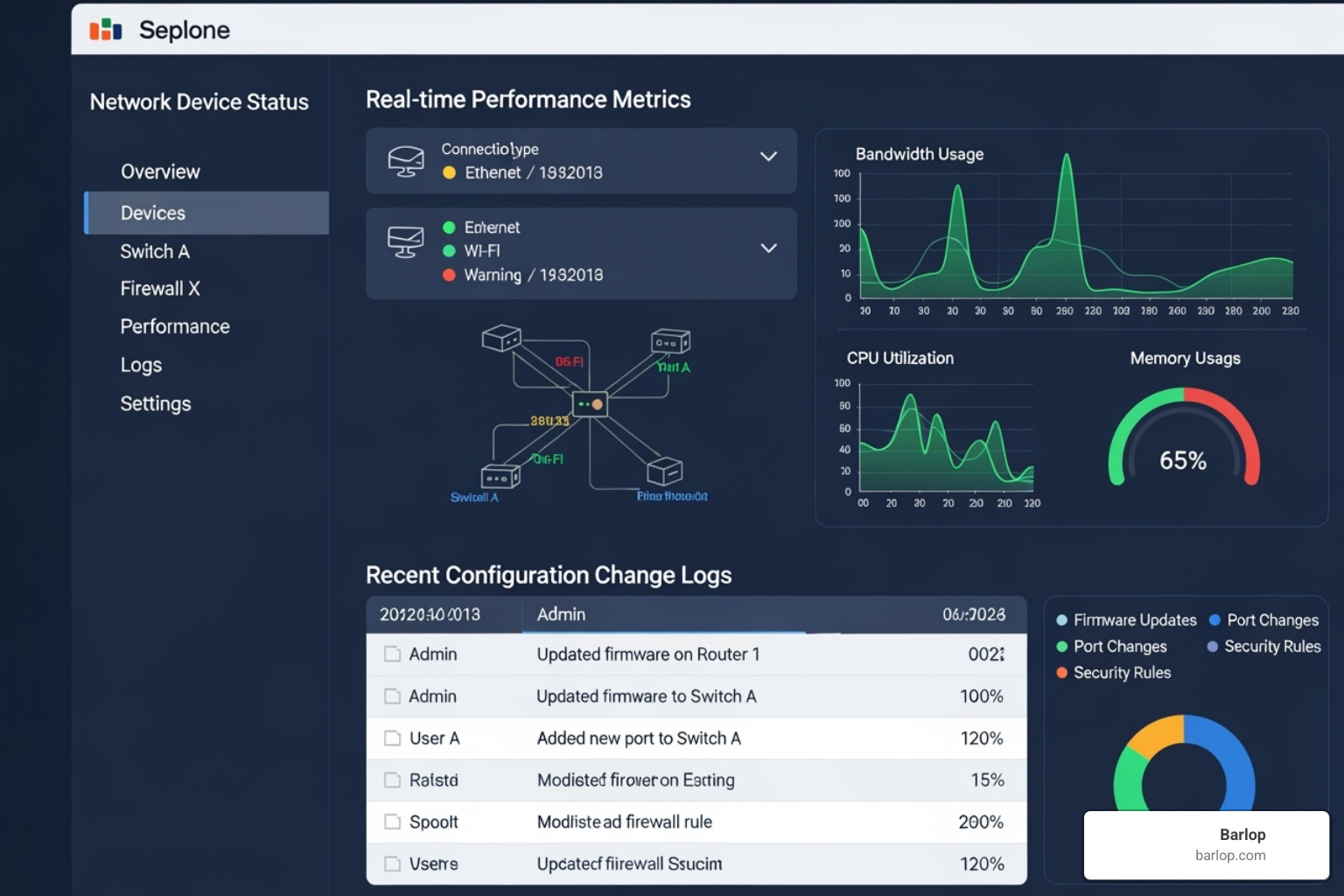 Think of a modern network configuration management solution as your network's personal assistant—one that never sleeps, never forgets, and never makes careless mistakes. It's far more sophisticated than the basic backup tools of yesteryear. Today's NCM platforms are comprehensive command centers that transform chaotic network operations into well-orchestrated symphonies.
The change is remarkable. When network issues strike (and they will), a robust NCM solution can reduce your Mean Time to Resolution (MTTR) from hours to minutes. Instead of frantically troubleshooting in the dark, your team can quickly identify what changed, when it changed, and roll back to a working configuration with just a few clicks.
But the benefits extend far beyond crisis management. Operational efficiency skyrockets when your team stops fighting fires and starts focusing on strategic initiatives. Network engineers can finally move beyond the endless cycle of manual updates and reactive troubleshooting to work on projects that actually move the business forward.
As your organization grows, scalability becomes crucial. A modern NCM solution ensures that adding new devices, locations, or even entire cloud environments doesn't exponentially increase your management complexity. It's like having a management system that grows seamlessly with your ambitions.
Perhaps most importantly, NCM future-proofs your network investments. Whether you're preparing for 5G deployments, IoT expansions, or the next wave of cloud technologies, a solid configuration management foundation ensures you're ready to adapt without starting from scratch. This strategic advantage is why many forward-thinking organizations turn to The Benefits of Managed Network Services to maximize their NCM investments.
[LIST] of Must-Have NCM Features
When evaluating network configuration management solutions, certain capabilities separate the game-changers from the also-rans. Here's what truly matters:- Automated Device Findy and Mapping creates your network's digital twin, automatically finding every device and mapping their relationships. No more outdated spreadsheets or surprise findies during outages.
- Configuration Backup and Restore serves as your network's time machine, creating validated snapshots and enabling one-click recovery to any previous working state.
- Real-time Change Management acts like a security camera for your configurations, tracking every modification with forensic detail about who, what, when, and why.
- Continuous Compliance Auditing functions as your always-on compliance officer, automatically checking configurations against industry standards and flagging deviations before they become problems.
- Automation and Scripting Engine transforms repetitive tasks into reliable, repeatable processes that eliminate human error and free up your team for higher-value work.
- Multi-Vendor Support prevents vendor lock-in nightmares by managing diverse device ecosystems through a single, unified interface.
- Role-Based Access Control (RBAC) ensures the right people have the right access at the right time, maintaining security without hindering productivity.
- Detailed Reporting and Alerts provides the visibility and proactive notifications you need to stay ahead of issues before they impact operations.